Welcome


4 Sucess Secrets
Follow this link to download our 4 Success Secrets to Becoming Green-Blooded

We have a big vision for a community that is life-affirming in all senses.

Read More about our Mission

Tennis, Anyone?

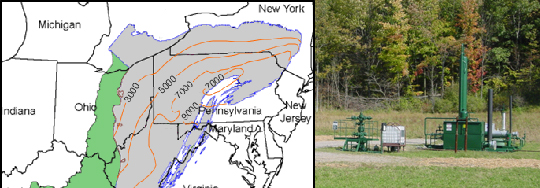
I’ve been reading a lot about fracking lately – the hydraulic fracturing technology that is being used to extract natural gas from deep in the earth’s crust. Right now, it feels like watching a tennis match. The two sides are quickly squaring off to be just as hardened as the “pro-choice / pro-life” battle lines. Until recently, this issue has been relatively ignored by the media. But now that the two sides are lobbing grenades at each other, the articles are flying.

Industry talking points include dismissive monikers like “the greens” and use sophisticated logic to imply that environmentalists stand between our country and future economic greatness. To hear them tell it, responding to claims of fracking pollution with study and caution will relegate our country to second-class status on the world stage. “If you’re opposed to drilling, you’re in favor of foreign oil” has been uttered by regular citizens at contentious public hearings.

On the environmental side, frustration bordering on hysteria is building about the inconceivable risks to New York City’s drinking water if fracking continues on unregulated and with little or no oversight. 200,000 wells are projected for drilling in New York and Pennsylvania; 50,000 in New York City’s drinking water watershed alone.

Indeed, the many environmental impacts of drilling activities are only just now beginning to be independently studied. The few studies that have been done raise serious questions that cry out for further study and better regulation and oversight:

    Links between flammable drinking water and fracking found in a Duke University Study.

    This one takes a look at the greenhouse gas footprint of drilling. The study is limited only to methane releases during capture of natural gas, which is significant enough for the authors to compare fracking unfavorably to coal. Maybe one day we’ll see a study that includes the emissions impacts from the thousands of diesel trucks that are also involved.

Perusing the comments posted online to articles in the Wall Street Journal, PBS, Huffington Post, and the New York Times, I am struck by how rigidly opinionated many of them are. I am also saddened by how deeply ignorant many people still are about the physics of this beautiful blue-green planet we live on. Our continued addiction to fossil fuels (I’m just as guilty), we are blind to the simple fact that these substances were deposited over millennia into the earth’s crust for a simple reason: life on earth is safer with such toxic materials sequestered away. The intelligent thing would be to leave them there and not drill, frack, pump, or mine them any more.

Lest I reveal my own bias too obviously (too late, right?!), here’s a question to consider: What if everyone is right? As long as no one insists on being 100% right, we just might get somewhere.

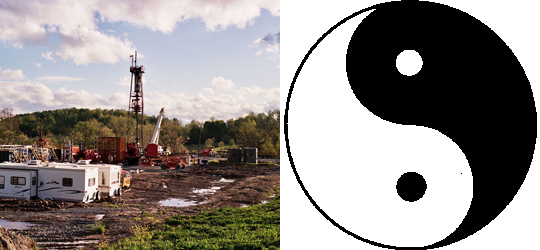
The idea is to follow the Taoist wisdom illustrated so beautifully in the yin-yang diagram. The right answer here is neither black nor white. Nor is it grey, for that matter. Instead, it is BOTH black and white. The Taoists speak of a third way, which is different from a middle way. We can arrive at the third way only through intelligent, open-minded discussion that is devoid of jargon and spin. The third way is the way of imagination and possibility. Humans are really good at imagining solutions – but only if we let up on the hostility and finger pointing.

In that spirit, consider these compelling aspects of the stances from each side:

  • It’s important for America to pursue energy independence, to wean ourselves off massive imports of foreign oil.
  • It’s not practical for us to give up modern life and go live in a cave.
  • Scientific study is a valid and important way to understand the potential risks from fracking.
  • The only way to clean an aquifer is not to pollute it to begin with.
  • Energy efficiency is the most affordable and safe “renewable energy” available. Negawatts are free and non-polluting. (A Negawatt is a watt of energy not consumed.)
  • Making our homes, cars, and industries more efficient is generating millions of new jobs.
  • Industry is primarily, if not exclusively, profit-motivated. This makes it necessary for some entity to prevent short-sighted decisions from harming the public welfare. Historically, this oversight has been provided by the government. It’s why children are no longer permitted to work as coal miners.
  • Automobiles are inherently dangerous, yet there are dozens of safety features that have been added in over the years. It is not unreasonable to ask the gas industry to design additional safety features into their equipment and procedures.
  • Business is not evil. Good businesses provide jobs, wealth, and meaning to their employees and the community.
  • Caring about the environment is not “soft” or stupid. Since we depend on the health of the natural world for our own survival, it is actually pretty smart to care.
  • Natural gas itself is a relatively clean-burning, versatile fuel that plays a vital role in our transition to a clean economy – one that does not rely on burning fuels but instead looks to efficiency and renewable energy.

In closing, I recommend everyone take a look at the Precautionary Principle, a well-respected science-based system. It shifts the burden of proof from the victim to the industry, since industrial concerns know their technologies and are in the best position to find safer alternatives to risky activities.

It is my fervent desire to see energy efficiency come into this debate. It would put a whole new spin on this tennis match.

Why doesn’t this country have a National Energy Plan?

The Marcellus formation contains a boatload of natural gas; getting it out is another thing entirely

Energy is arguably the most important issue facing our economy, our society and the future of our democracy over the next 50 years. Don’t we want to be prepared?

Recently, I’ve been rethinking some of my assumptions about energy and all the buzzwords, trends, crises and controversies that tag along with that word. Pardon me while I clear my mind of a few strays so I can write coherently. Peak Oil, anthropogenic climate change, Marcellus shale gas, Amory Lovins, renewable energy, cleantech, ARPA-E, energy audits, Dick Cheney, efficiency, IPCC, ANWR, commissioning, biomass, Elon Musk, trash to energy, algae, energy independence, Shai Agassi, greenhouse gases, carbon emissions, whew! That feels better.

Now for the questions that are rolling around in my head . . .

Does it matter if climate change is or isn’t caused by human activity?

Is it even truly possible to accurately predict effects of climate change, given the computer models we have, the chaotic nature of the earth’s climate, and the number of assumptions that must be made?

Does accepting the impossibility of certainty about our future climate make any difference?

Can we power the vast churn of materials through our hyper-consumerist society with renewable energy alone?

And what about the fact that we currently (that’s, TODAY) have all the technology and know-how to make our buildings 75% more efficient – or more?

Did you know that buildings use 75% of the electricity in this country and half the energy in general?

And that about 60% of all electricity is generated by burning coal? (I know that’s true for Maryland; maybe it’s higher nationwide.)

And that whole swaths of the Appalachian Mountains are being leveled to get at the coal more easily? (Byproduct of this: streams in the valleys get filled in with all the gunk, as in, killed.)

And that the Marcellus shale formation is now in the crosshairs of an uncountable number of natural gas prospecting companies? (The track record of whose activities in the West would make your hair stand on end. And don’t even get me started on all the exemptions from our nation’s most sacred environmental – and human health – protection laws that these same industries enjoy in Cheney et al’s 2005 Energy Bill, still in effect.)

How motivating is it to be told that you have to sacrifice in order to be more efficient and harmonious with the earth?

Do you believe it when experts say that overhauling our industrial economy to become radically cleaner and more efficient is the biggest opportunity for innovation and economic development in our nation’s history? That it’s a strategic imperative, a key to national security, and a way to regain our stature as an economic superpower?

In the absence of any coherent national policy, what is there to do?

Fortunately, that last one has an easy answer: plenty. All across the nation, at the local level, states, counties and cities are crafting their own energy policies. They are taking action locally to reduce carbon emissions, retrofit buildings to be more efficient, encourage bicycling, public transit, walking, car sharing and other transportation alternatives, develop food locally, support and promote local businesses, and hold eco-festivals to build awareness and showcase alternatives, among many other activities.

And, personally — whether at home or in your business — here are a few articles to get ideas and inspiration from:

Shift Your Mindset from Hell to Heaven — includes three tips on how to do this

Practical Tips to Save Energy at Home — our most commented-on article. Be sure to read the comments; they push the tips up to over 20 at least.

How Low Can You Go? — about saving energy and money (while also reducing carbon emissions) in business

Nationally, websites abound to help individuals, communities, and companies to become more environmentally friendly and, possibly more broadly appealing, to use resources more efficiently, thereby saving money. A small sampling of those sites:

350.org

Writer / activist Bill McKibben is a co-founder of this site which is dedicated to raising the world’s awareness of the number (350 parts per million) that indicates a safe level of CO2 in our atmosphere. Has enjoyed phenomenal success and attracted wonderfully creative projects that move and inspire.

LowImpact Living

Rate your impact, find local services and products to help go green. Geared to lifestyle and home, but the categories and topics are educational.

Greenbiz.com

A suite of sites including blogs, newsletters, videos, and reports. Includes ClimateBiz.com, GreenerDesign.com, and GreenerBuildings.com. Very high-quality, trustworthy source of news, analysis, and information. Now tracking consumer trends with the “Green Confidence Index.”

Stand for Green

A fun do-it-yourself site for businesses to create a green mission statement and begin to get the word out, so your clients and prospects know you are green.

The U.S. Green Building Council (USGBC), Architecture 2030, and Building Green

While very different organizations with different missions, what these have in common is their leadership in this conservation part of the cycle. Architecture 2030 has wonderful graphic design, making complex concepts easily understood. Their material is meticulously researched and cited. For the past 10 years, the USGBC has been transforming the design and construction industry with its LEED Green Building Rating System. The Building Green website has impeccable standards, deep research, and lively writing. Independently-researched articles on materials, technologies, systems, policy, and trends are presented both in the journal and in a blog.

Just to Recap

Energy in this country is Job One. How we use it, how we save it, and how we develop new, less wasteful forms of it. In fact, I feel so strongly about this that I’ll just say this: “It’s the energy, stupid.”


A Fictional Letter to the New York Times

This is a preview of some writing I’ve been doing lately. It’s a fictional letter to the editor of the New York Times, written (again, fictionally) on December 12, 2009. Enjoy! Comments most welcome.

To the people of New York City:

I invite you to imagine life fifty years from now. Set politics and religion aside, and just imagine New York in the year 2059.

Going to the Stock Exchange? Better take a water taxi – unless you’re a strong swimmer. The buildings around Wall Street were sealed off years ago on their lower stories and the streets are now navigated with water taxis and gondolas, similar to Venice. The water levels do fluctuate several feet at times, but New Yorkers are quite adaptable.

In fifty years, the coastlines of Brooklyn, Long Island, and the Bronx have been dramatically altered, in many cases beaches and whole communities erased. The resulting move inland has caused real estate prices to rise ever higher – harder still to imagine than a watery Wall Street, I know.

Fifty years hence, higher sea levels have given severe storms much more water to funnel toward the city. Surges of water come from both Long Island Sound and the Verrazano Narrows. Vital infrastructure — hospitals, sewage treatment plants, communication conduits – has been paralyzed by flooding with corrosive seawater. It took decades and billions of dollars to rebuild them, and some were simply abandoned.

Like hot weather? Hope so, because here in New York, in fifty years, we now have close to 50 days a year with temperatures over 50 degrees. And about 600 heat-related deaths each year.

Are you fond of good music and good parties? You’ll have to find them closer to home, because New Orleans no longer exists. It was buried under water about ten years ago and has been left for dead.

Is this just fantasy, or, at best, science fiction? Afraid not. And New York is not alone. Since all life on the planet is connected in an intricate web, the effects are everywhere. Collapsed economies, dying ecosystems, disappearing fresh water sources, floods, droughts, resource wars, and increased terrorism, to name just a few. I’ll give just a few examples, but read on to the end, because I also have very specific advice for how you can avoid or at least mitigate these effects. Think of it as a legacy project. What do you intend to leave behind for your loved ones?

Humanity opened a Pandora’s box with our years of burning fossil fuels and emitting the carbon dioxide that warmed our atmosphere. Once nature began her response, she magnified the effects pretty quickly. Think: runaway freight train.

I had a lot of paragraphs written about species extinction, disappearing forests, dying coral reefs, droughts that have killed millions, hundreds of millions of people homeless from coastal flooding. Millions with no access to fresh water because their sources – mountain glaciers – have melted and gone the way of the dinasaurs.

But you don’t live near a melting glacier, do you? And you probably don’t know any of those people who have been flooded out or starved by famine.

I could also go on about worldwide instability of governments, social structures, and economic systems. About the intensification of the divide between “haves” and “have-nots.” Between rich countries in temperate zones, where wealth and technology provide a buffer against climate risk and poor countries close to the equator that are deeply exposed to the twin climate hazards of flood and drought.

But that’s all pretty abstract and far in the future. Reading that probably didn’t even raise your heart rate.

I’ll also refrain from going into detail about fuel costs and trade embargoes that have wreaked havoc with world economies. About political and climate refugees who are increasingly hopeless, funneling into global terrorist cells and crime syndicates.

Because, let’s face it. In fifty years, you may very well not be alive, having lived a full life and died well.

Ah, but your children or grandchildren, nieces or nephews will still be around to clean up the mess.

Today, scientists and policy makers are currently arguing passionately back and forth over what to do about all this. Some even question whether climate change is real, or whether it’s caused by human activities, or whether it’s happening now. Wonder no more, because here are the answers to those questions:

Yes, yes, and yes.

Besides, and this is harsh, the earth doesn’t care what you believe in.

That out of the way, let’s roll up our sleeves and talk action. If I lived fifty years in the future, I would have a unique perspective on things. In that spirit, here are my suggestions, offered with deep respect and in no particular order. I have divided them into two categories: 1) shift your thinking and 2) things to do now.

Shift your thinking (or, suspend disbelief, even just until the end of this letter):

  • Don’t fall prey to the schism of believers and non-believers.
  • Don’t rely too much on the science, especially when it threatens people’s values. This will only create resistance and denial.
  • Find ways to talk about the same thing, not a middle ground. There is always a place where people have more in common than we have differences.
  • For those of you who think climate change is a lot of hooey, putting major efforts into innovations in energy efficiency and renewable, clean energy is still the greatest economic development opportunity since the early days of the industrial revolution. Possibly ever. Look around. It’s not just the European countries who are investing heavily in this; it’s also China and India. You don’t want the U.S. to be left behind, do you?
  • This is not about instituting world government, taking away civil liberties, or redistributing wealth.
  • Climate change is not a distant threat, a “what if;” it is already upon us.
  • Never underestimate the critical role of public discourse, civic values, political leadership, cultural habits and economic interests, even spiritual beliefs. Science, wealth and technology do matter, but culture and politics trump them.

Things to do now:

  • Put about 75% of your efforts on making everything in your economy as energy-efficient as possible. Start with buildings, transportation, and agriculture. You have all the technology and knowledge you need to make it all at least 50% more efficient right now. By the way, that 50% is a very low number. I could just as easily have said 85%, but I didn’t want to sound too crazy.
  • Put another 75% into investing in innovations in clean energy sources. No, nuclear doesn’t count. Sorry. And, yes, I realize that adds up to more than 100%. Have I mentioned that there’s plenty of work for everyone?
  • Plant trees. Lots of trees, everywhere you can.
  • Hate to say it, but you’re going to have to build levees and sea defenses. People are already talking about and even designing them. You just didn’t know until I told you.
  • Do not allow fear or despair, or even anger to be your only response.
  • Stop arguing about things that do not matter.
  • Look at your neighbors, smile more. Dance.
  • Look inside; the answers are all within you.
  • And never, never forget that you belong here. This is your home. Humanity is your family. You can design any future you want.

This is a country founded on a hatred of tyranny. Failing to do everything you can to address climate change now is a form of intergenerational tyranny. This generation would, in effect, be imposing its will and wasteful way of life on future inhabitants of this planet, dooming them to the suffering that we residents of 2059 see on a daily basis.

How change really happens

drawings by Alyssa Dennis
We are pleased to make readers aware of a new book, just released, called, “Change Of Heart: What Psychology Can Teach Us About Spreading Social Change.” This book, by author Nick Cooney,  looks at 80 years of scientific research conducted on human psychology and related fields, and distills that research down into practical tips that environmental organizations and other non-profits can use to more effectively persuade the public and create social change.

Cooney is the founder and director of The Humane League, an animal advocacy organization based in Philadelphia, PA that focuses on farm animal protection issues.

“Change Of Heart” provides science-based answers to many questions that are hotly debated among environmentalists. For example, is it better to encourage the public to adopt small, simple changes (like using CFL light bulbs) or to ask for more major life-altering changes (like getting rid of one’s car)? What messages and techniques have been proven to succeed in reducing home energy use and increase recycling? And what role does “green consumerism” play in helping – or harming – the environmental movement?

We already have the information, the expertise, and the technology to make the shift to a clean-energy, environmentally-restorative economy. There are plenty of smart people working on this front. Behavior change, and even making the case for this as a preferable course of action, have a bit of catching up to do. That’s why we are so excited about books like this one and the Heath brothers’ “Switch.” Here is an excerpt:

Narrow Their Options

When a farmer is trying to herd animals from a larger area into a smaller one, they’ll often create a chute that starts wide and gets narrower and narrower. Similarly, when we are trying to get someone to take an action it is helpful to narrow their options. Offering people too many choices will make them more likely to choose nothing at all. A study of eight hundred thousand workers found that the number of retirement funds offered by an employer was inversely related to the number of workers that signed up for any retirement fund (Iyengar, Huberman and Jiang). The more retirement fund options they were given, the less likely workers were to choose any fund—which probably had negative consequences for workers and their families.

In another study, student participants were presented with two hypothetical choices for what they could do that evening:  study in the library or attend a lecture by an author they admired who was in town for one night only. Only twenty-one percent chose to study, with seventy-nine percent choosing to the more enjoyable activity. In the second round of this study, participants were given three options:  the library option, the author option and also the option to watch a foreign film they had wanted to see. In this second study, forty percent of participants decided to study, with sixty percent choosing one of the more enjoyable activities. Giving students two good alternatives to studying made them less likely to choose either alternative (Redelmeier and Shafir 1995).

In trying to get people to do something positive, we’re often tempted to give them an array of choices based on the idea that the more choices they have, the more likely they’ll find one of them acceptable. Environmental campaigners might provide a list of twenty-five different things a person can do to help protect the planet. Gay rights groups might create a similar list of actions people can take to promote equality. Health organizations might create a long list of foods rich in vitamins and minerals that should be part of a healthy diet. The research suggests that these groups would be more successful if they focused instead on promoting a few key actions.

Activists should also be aware that there is a big difference between education meant to stimulate thought and education meant to stimulate action. There are many shades of grey to every issue, and the more we think about an issue the more complexities we will see. If we are a college professor and our goal is to hone our students’ critical thinking abilities, then ongoing discussion that examines every aspect of an issue is a good thing. But if we as activists are trying to educate people in order to motivate them to do something, then our communications need to simplify the issue and call for clear, specific action. We need to eliminate distractions and narrow options.

We will feature more excerpts soon. In the meantime, you can read more on the book’s website.

The Weekly Green: Juice for the Journey #25

Thomas Jefferson's

Week 24

I am a warrior, that my son may be a merchant — and his son, a poet. ~ Thomas Jefferson

The Founding Fathers (and Mothers) risked it all – their property, their status, and their very lives – for the sake of honor, duty, and radical ideas about human dignity and freedom. Jefferson reminds us of his abiding concern for future generations, a sentiment shared by many environmentalists and social justice activists in our time. The term, “seventh generation,” has been adopted by some environmentalists from the Iroquois Confederacy, who came to decisions through careful consideration in context of both ancestors and descendents. Interestingly, we are now the seventh generation after Mr. Jefferson. This week, how can your actions demonstrate concern for future generations?

More: Read John Mohawk’s moving essay about the Iroquois (Haudenosaunee) approach to peacemaking.

Bonus #1: Read about seventh generation sustainability and the Great Law.

Bonus #2: Thom Hartmann has written many evocative books, including one called “What Would Jefferson Do?”

Read the Weekly Green from Week 24 here.

Don’t miss your Weekly Green! Subscribe to receive via email. Go up on the right column, to the box under the “Search” box, where it says, “Enter your email address.”

We always love to hear from you! How juicy is this quote for you? Leave a comment.

The Weekly Green: Juice for the Journey #24

photo by: Julie

Week 24

Barn’s burnt down. Now I can see the moon.  ~ Masahide

When something unexpected or devastating happens, my first reaction is often to reject it, push it away, or otherwise obsess over it. I might question, fix, analyze, or otherwise seek to minimize the blow. Thinking it’s my fault or something I could have prevented mistakenly puts me at the center in an unrealistically black-and-white world. This week, can you open to a wider view and see a setback as a gift that is simply not yet fully understood?

More: Poets and artists have the gift of vision that allows them to see beauty in the midst of challenge. View the “350 Sky” video by Daniel Dancer. On Dancer’s website is this tagline: “Art Changes People – People Change the World.”

Read the Weekly Green from Week 23 here.

We always love to hear from you! How juicy is this quote for you?

The Weekly Green: Juice for the Journey #23

photo by: Julie

Week 23

I arise in the morning torn between a desire to save the world and a desire to savor the world. This makes it hard to plan the day. ~ E.B. White

Much as I love his humor, maybe White has set this up as a false dichotomy. What if the best way to save the world is to savor it? The play between spirit and matter is so fascinating and mysterious. Our senses are exquisitely designed to tune in to the world around us, to bring us information and temptation, moment by moment. How can savoring the world help you in your quest to save it?

More: Save or savor? We have much to give thanks for, here in North America. This brief video puts it all in hauntingly beautiful perspective.

Read the Weekly Green from Week 22 here.

We always love to hear from you! How juicy is this quote for you?